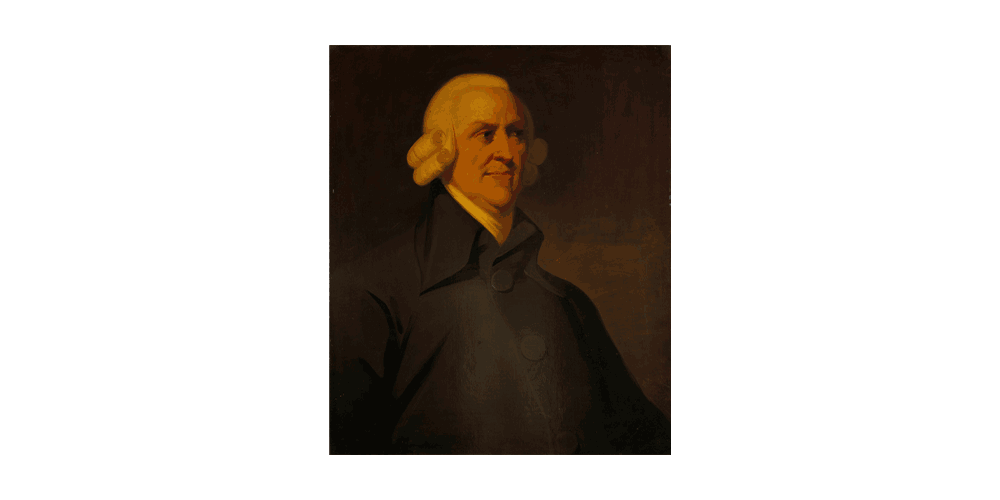
Adam Smith was a Scottish economist, philosopher, and author from the 18th century, often referred to as the father of modern economics. He opposed mercantilism and strongly supported laissez-faire economic policies. In his initial work, “The Theory of Moral Sentiments”, he introduced the concept of an invisible hand, which describes how free markets tend to self-regulate through competition, supply and demand, and individual self-interest.
The Biography
The documented history of Smith starts with his baptism on June 5, 1723, in Kirkcaldy, Scotland. While his exact birthdate isn’t recorded, he was brought up by his mother, Margaret Douglas, following the passing of his father, Adam Smith. At just 13, he enrolled at the University of Glasgow and later went to Balliol College at Oxford University, where he delved into European literature.
Upon his return to Scotland, Smith conducted a series of public lectures at the University of Edinburgh. The success of these lectures paved the way for him to secure a professorship at Glasgow University in 1751. He went on to become the Chair of Logic in 1751 and then the Chair of Moral Philosophy in 1752. Throughout his time teaching and working at Glasgow, Smith focused on publishing some of his lectures. His book, “The Theory of Moral Sentiments,” was finally published in 1759.
In 1763, Smith relocated to France to take on a better-paying job as a personal tutor for Charles Townshend’s stepson, who was an amateur economist and would later become the Chancellor of the Exchequer. While in France, he rubbed shoulders with notable figures like Benjamin Franklin and philosophers such as David Hume and Voltaire.
After coming back from France and settling down in his hometown of Kirkcaldy, Scotland, Smith released his most significant work, “An Inquiry into the Nature and Causes of the Wealth of Nations,” commonly known as “The Wealth of Nations,” in 1776.
Adam Smith passed away on July 17, 1790, at the age of 68 in Edinburgh, Scotland, and he was laid to rest in Canongate Kirkyard.
Conclusion
Smith is famous for coming up with the idea of gross domestic product (GDP) and his theory on compensating wage differentials. This theory suggests that jobs that are dangerous or not very appealing usually offer higher pay to draw in workers. His biggest impact on economics was his 1776 book, “An Inquiry into the Nature and Causes of the Wealth of Nations.” The concepts he introduced are still influential in the classical school of economics and in organizations like the Adam Smith Institute, which is the top free-market neoliberal think tank in Britain.